
Why Sliding Drawer Freezer Racks Minimize Temperature Fluctuations Better Than Standard Racks
20th Mar 2026
Sliding drawer freezer racks minimize temperature fluctuations by allowing researchers to access a single cryobox without pulling the entire vertical rack assembly out of the freezer environment. This targeted access reduces ambient air exposure, preserves the internal microclimate of the unit, and allows for much faster temperature recovery to protect the integrity of sensitive biological samples.
The Critical Role of Thermal Stability in Ultra-Low Storage
In the world of life science research, a few degrees of temperature variance can be the difference between a successful assay and a ruined year of work. Most laboratories utilize upright freezers for their storage density, but the way samples are accessed within those units is often an overlooked variable in sample stability.
Standard side-access racks exacerbate this problem. To get to a box at the back or bottom, the entire rack, often containing multiple boxes, must be removed and placed on a benchtop. During a recent audit for a clinical research firm in Downtown, we observed that samples in standard racks remained at room temperature for an average of three minutes during sorting, leading to significant "transient warming events."
Debunking the Myth: "All Rack Styles Expose Samples to the Same Amount of Heat During Retrieval"
A common industry misconception is that as long as the freezer door is closed quickly, the specific rack type doesn't matter. This is factually incorrect. Standard vertical racks act as heat sinks; once removed, the metal warms rapidly. When reinserted, they introduce a massive thermal load back into the freezer.
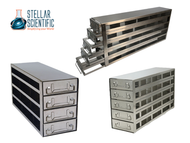
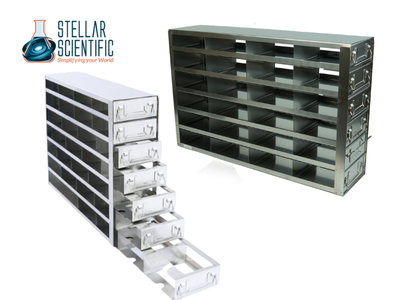
Stainless Steel Laboratory Freezer Drawer Rack for 2 Inch Cryo Boxes, Three Deep And Five High, by contrast, are designed to remain anchored well inside the freezer. You only extend the specific drawer needed. This creates a "baffle effect" where the other drawers in the rack act as a thermal barrier, keeping the surrounding boxes shielded from the influx of warm air.
Standard Side-Access Racks vs. Sliding Drawer Racks
To understand the ROI of your storage equipment, consider the following technical comparison:
Standard side-access racks and sliding drawer racks differ significantly in performance, efficiency, and usability:
- Cold Air Loss per Retrieval: Standard side-access racks have high cold air loss since the entire rack is removed, while sliding drawer racks minimize loss by extending only a single drawer.
- Sample Exposure Time: Standard racks expose samples for 2–5 minutes, whereas sliding drawer racks reduce exposure to under 30 seconds.
- Ergonomic Strain: Standard racks require heavy lifting, leading to high strain, while sliding drawer racks offer low strain with a smooth sliding mechanism.
- Frost Accumulation Rate: Standard racks experience rapid frost buildup due to high air turnover, while sliding drawer racks have minimal frost from reduced air exchange.
- Ideal Sample Types: Standard racks are suited for bulk storage with low access frequency, while sliding drawer racks are ideal for high-value samples that require frequent access.
Steps to Audit Your Freezer's Temperature Recovery Time
If you are managing an upright freezer with drawer organization, you should regularly audit how your hardware impacts your compressor's lifespan and sample safety.
- Establish a Baseline: Use a calibrated data logger to monitor how long it takes for your freezer to return to its set point after a door opening using standard racks.
- Identify High-Frequency Samples: Note which samples are accessed daily. These are your highest-risk points for thermal degradation.
- Track "Out-of-Freezer" Time: Measure how long a rack stays on the bench during retrieval. In a busy Midtown lab, this is often longer than anticipated.
- Analyze Recovery Spikes: Look for large spikes in your temperature graph. If they are frequent, your racks are likely the culprit.
- Calculate the Delta: Compare these metrics against a section of the freezer outfitted with a rack with drawers.
Applying our "Stellar Service Standards" to Solve This
As a family-owned business, we've spent the last decade building a reputation for insanely great service, technical expertise, and a carefully curated selection of high-quality lab essentials for the tens of thousands of scientists we serve. Our mission remains simple: to inspire discovery and keep scientists happy by providing a comprehensive range of lab essentials and general lab equipment that no life science lab can do without, ensuring each product meets our high standards for quality and performance.
To solve the issue of thermal instability, we apply our proprietary Stellar Service Standards to every equipment consultation. This involves:
- Precision Mapping: Matching the rack dimensions to the specific interior clearance of your freezer model to ensure a perfect seal.
- Integrity Verification: Selecting the most durable and well-constructed of all freezer rack types, stainless steel, to ensure long-term performance.
- The Identification Protocol: Using the built-in card catalog slots on the front of our upright freezer drawers to identify contents without even opening a drawer.
The Engineering Behind the Best Upright Freezer Drawers
The most durable and well-constructed of all freezer rack types are those built with heavy-gauge stainless steel. These Stainless Steel Laboratory Freezer Drawer Rack systems are designed to be left inside the freezer so that only the specific drawer needs to be extended to retrieve the necessary sample or contents.
Because of their heavy-weight construction, these racks can be quite heavy, especially the larger variations. This weight allows them to remain anchored well inside the freezer even when drawers are fully extended. However, they can be difficult to maneuver when defrosting a laboratory freezer, so it is often advised to park them on lower-level shelves for easier removal.
If your lab personnel are slight in stature, or if you are working in a fast-paced environment where speed is key, consider a laboratory freezer rack with a sliding tray system as a lightweight alternative that performs in essentially the same manner.
People Also Ask (FAQ)
What is the best material for a freezer rack with drawers?
Stainless steel is the gold standard due to its corrosion resistance and ability to withstand $-80°C$ temperatures without becoming brittle.
How do I know if a drawer rack will fit my freezer?
You must measure the internal depth, width, and height of your freezer shelves. Ensure you account for the inner door clearance.
Can I use drawer racks for 3-inch boxes?
Yes. While 2-inch boxes are common, specialized drawer racks are available specifically for 3-inch boxes used for larger vials.
Your Partner in Scientific Discovery
At Stellar Scientific, we believe in offering only the highest quality products that directly contribute to advancing scientific progress. Our guiding principles are precision, integrity, and a commitment to providing exceptional customer service. Backed by an exceptional customer support team, Stellar Scientific is a favorite among the scientific community. Our expert team is passionate about science and ready to assist you with any questions you may have.
Ready to protect your samples with the industry's most reliable storage solutions?
Explore our full range of Drawer Freezer Racks here, and reach out to our team for personalized recommendations. Whether you’re ready to make a purchase or need guidance, we’re here to support your needs every step of the way.