

Why 2-Inch Lab Freezer Boxes and Racks Dimensions Are the Gold Standard for ULT Storage
Posted by Lee Lowenstein on 19th May 2026
The 2-inch height for lab freezer boxes and racks is the gold standard for Ultra-Low Temperature (ULT) storage because it provides the ideal volume-to-density ratio for 1.5 mL and 2.0 mL microtubes. This specific sizing maximizes internal freezer capacity by eliminating vertical dead space while maintaining compatibility with the vast majority of upright and chest freezer rack systems.
The Logic of the 2-Inch Standard in Cryogenic Environments
In life science research, ULT freezer space is often the most expensive square footage in the building. Maximizing the number of samples stored per cubic inch is a mechanical necessity for operational efficiency. The "2-inch" designation refers to the external height of the storage box (typically 50mm to 53mm), a dimension engineered to house the world’s most common lab consumables: microcentrifuge tubes. When these vessels are seated inside a 2-inch box, there is exactly enough clearance for the lid to close without stressing the tube caps, ensuring the freezer remains energy efficient by minimizing air gaps.
Maximizing Density with 2 Inch Box Freezer Racks
When you utilize 2 inch box freezer racks, you are implementing a precision-tuned storage strategy. These racks are built with shelves spaced specifically to accommodate these standard boxes with tight tolerances. If a laboratory uses 3-inch boxes for 1.5 mL tubes, they effectively waste 33% of their vertical storage potential in every row. Across a standard 13-shelf rack, that lost space equates to hundreds of missing samples that could have been preserved.
Specialized Configurations: Drawer vs. Sliding Tray
While the box is the unit of storage, the rack configuration defines your daily workflow and sample safety. Choosing the right lab freezer boxes & racks depends on how frequently your team needs to interact with the inventory.
Drawer Freezer Racks
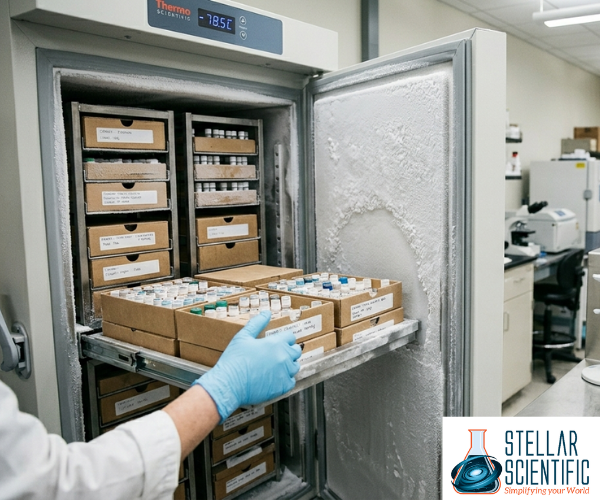
For long-term repositories where organization is the primary goal, drawer freezer racks are the preferred choice. These units allow a researcher to pull out a single, isolated drawer to retrieve a specific box without exposing the rest of the rack to ambient temperatures. This localized access is essential for maintaining a stable thermal mass and preventing the "snowstorm" effect of frost pull-in on neighboring samples.
Sliding Tray Freezer Racks
In high-throughput environments where samples move daily, sliding tray freezer racks offer a significant ergonomic advantage. The sliding mechanism provides a smooth transition that allows a lab manager to view an entire shelf of boxes at once. This speed of identification is a key component of information gain; the faster you locate a vial, the less risk there is of ambient heat affecting the biological integrity of your materials.
The Stellar Scientific Framework: Our Commitment to Discovery
At Stellar Scientific, we operate with a specific mission: our expert team is passionate about science and ready to assist you with any questions you may have. We aren't just shipping hardware; we provide great service and technical expertise through a carefully curated selection of high-quality lab essentials. We believe our role is to inspire discovery by removing the logistical hurdles researchers face. By maintaining high standards for quality and performance at a fair and competitive price, we ensure your grant funding is directed toward your results rather than under-performing equipment.
Technical Advantages of Standardized Dimensions
- Thermal Mass Consistency: Uniformly sized boxes allow for laminar airflow within the freezer, preventing "hot spots" that occur when mismatched boxes trap air.
- Structural Integrity: Whether using water-repellent fiberboard or high-grade polypropylene, 2-inch boxes are engineered to withstand the expansion cycles of -80°C environments.
- Inventory Compatibility: Most digital LIMS (Laboratory Information Management Systems) are pre-configured for 9x9 or 10x10 cell dividers, which are the native internal formats for the 2-inch footprint.
Engineering the Perfect Cold Chain
Integrating the right storage hardware is the final step in a successful cold chain. Whether you are preserving genomic DNA, proteins, or volatile chemical compounds, the physical housing is your first line of defense against sample degradation. Standardizing on the 2-inch format ensures your laboratory remains compatible with future innovations in ULT technology and rack design.
Elevate Your Research with Stellar Scientific
At Stellar Scientific, we understand that you aren't just looking for storage; you are looking for reliability. Our knowledgeable suppliers understand your research needs and challenges because we focus exclusively on the tools that drive scientific progress. We want you to feel confident and reassured that your samples are protected by the highest quality products on the market.
What sets us apart is our extensive selection of specialized products paired with a customer-centric approach. Our attention to detail ensures you receive the exact solutions you need, backed by service that goes beyond the transaction. You can contact us today.
Optimize your storage footprint today:
- Review our 2 inch box freezer racks.
- Upgrade to drawer freezer racks.
- Browse sliding tray freezer racks.
People Also Ask (FAQ)
What are the dimensions of a standard 2-inch freezer box? A standard 2-inch box typically measures 5.25 x 5.25 x 2 inches (133 x 133 x 50 mm). It is the universal size for most upright freezer rack systems.
Can I use 2-inch racks for 3-inch boxes? No. A rack designed for 2-inch boxes will not have the vertical clearance required for 3-inch boxes. Always match your rack "shelf height" to your box height.
Which is better: Cardboard or Plastic freezer boxes? Cardboard is cost-effective and handles ultra-low temperatures well if it has a moisture-resistant coating. Polypropylene boxes are more durable, often autoclavable, and better suited for labs with high moisture or liquid nitrogen (LN2) needs.