

Variable vs. Fixed Compressors: Which Offers Better Temperature Uniformity in Pharmaceutical Refrigerators
Posted by Lee Lowenstein on 29th Apr 2026
Variable-speed compressors provide superior temperature uniformity by continuously adjusting motor speed to maintain a precise set point. While fixed-speed models rely on "on-off" cycles that cause thermal fluctuations, variable-speed technology eliminates these swings to protect sensitive biologicals. This constant modulation ensures the internal environment stays within a narrow window, neutralizing the risk of freezing or overheating.
These units match cooling output to the specific heat load, avoiding the massive electrical inrush required to restart conventional motors. By running at sustained, lower RPMs, they tighten temperature ranges across all shelves while reducing mechanical wear and energy use. This refined approach provides the stable climate necessary to satisfy regulatory audits and preserve the integrity of critical research data.
Understanding Compressor Technology in Pharmacy Refrigerators
When selecting equipment for the storage of high-value vaccines, reagents, and medications, the cooling engine and the compressor are the most critical components. In the realm of pharmaceutical refrigerators, two primary technologies dictate how cold air is generated and maintained: fixed-speed (conventional) and variable-speed (inverter) technology.
The Mechanism of Fixed-Speed Compressors
Traditional cooling systems utilize a fixed-speed compressor. These units operate at a single speed: 100% capacity. When the internal temperature of the unit rises above the set threshold, the compressor kicks on at full power until the target temperature is reached, at which point it shuts off entirely. This "hunting" behavior results in a sawtooth temperature profile, where the environment constantly oscillates between slightly too cold and slightly too warm.
The Precision of Variable-Speed Compressors
In contrast, modern high-performance units, such as a premium Haier Biomedical Pharmacy Refrigerator (+2 to +8 °C, 118 L (4.2 cf)), often utilize variable-speed technology. Instead of stopping and starting, the motor slows down or speeds up based on the actual cooling demand. If the door is opened and a small amount of heat enters, the compressor makes a minor adjustment to compensate. This results in a near-flat line of temperature uniformity, which is essential for maintaining the integrity of volatile compounds.
The Impact of Temperature Uniformity on Product Efficacy
In a clinical setting, "close enough" is rarely sufficient. Many modern medications are extremely thermolabile, meaning even brief excursions outside the +2°C to +8°C range can lead to protein denaturation or reduced potency.
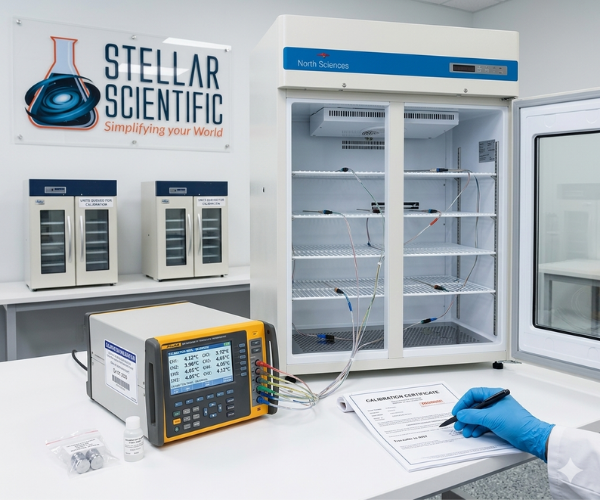
Eliminating Cold Spots and Hot Spots
Because variable-speed compressors provide a constant refrigerant flow, they work in tandem with advanced airflow systems to ensure that every shelf, from the top corner to the bottom drawer, maintains the same temperature. Fixed-speed units are more prone to "cold spots" near the evaporator during the high-intensity cooling phase, which can freeze products placed too close to the cooling source.
Recovery Times After Door Openings
Lab managers and pharmacists understand that pharmacy refrigerators are accessed frequently throughout a shift. Variable-speed motors react instantly to these thermal challenges. By ramping up speed immediately upon detecting a rise in temperature, they return the cabinet to the set point much faster than a fixed-speed motor, which may have a built-in delay before the next cycle begins.
Energy Efficiency and Mechanical Longevity
Beyond temperature uniformity, the choice of compressor technology has long-term financial and operational implications.
- Energy Consumption: Variable-speed compressors are remarkably more efficient. Because they rarely need to overcome the massive electrical "inrush" current required to start a motor from a dead stop, they consume significantly less power over 24 hours.
- Noise Reduction: Fixed-speed units are known for the audible "clunk" and hum when they cycle on. Variable-speed systems operate at much lower decibels, contributing to a quieter, more focused laboratory or clinical environment.
- Reduced Wear and Tear: The constant stopping and starting of a fixed motor puts immense mechanical strain on the system. Variable-speed motors operate more smoothly, often resulting in a longer equipment lifespan.
Our Commitment to Scientific Excellence
At Stellar Scientific, we understand that a refrigerator is not just a box; it is a vital safeguard for your research and patient care. Our expert team is passionate about science and ready to assist you with any questions you may have. We take pride in providing great service and technical expertise to ensure you select the right cooling solution for your specific application.
Our carefully curated selection of high-quality lab essentials is designed to inspire discovery by removing the variables that can compromise your data. We hold high standards for quality and performance at a fair and competitive price, ensuring that every piece of equipment we supply, from a compact Haier Biomedical Pharmacy Refrigerator (+2 to +8C, 85L (3 cubic feet)) to large-capacity floor models, meets the rigorous demands of the modern scientist.
Selecting the Right Unit for Your Facility
Choosing between these technologies often comes down to the sensitivity of the materials being stored.
High-Sensitivity Storage
For vaccines, expensive biologicals, and long-term clinical trials, variable-speed technology is the industry standard. The Haier Biomedical Pharmacy Refrigerator (+2 to +8 °C, 118L (22.6cf)) (often categorized by its high-efficiency performance in various sizes) provides the sophisticated thermal control required to satisfy strict regulatory audits and internal quality control protocols.
General Purpose Storage
If you are storing non-critical reagents or items with a wider temperature tolerance, a high-quality fixed-speed unit may suffice. However, as energy regulations tighten and the cost of specialized pharmaceuticals rises, the "total cost of ownership" typically favors transitioning to variable-speed units.
Why Precision Matters in Cold Chain
When you source pharmaceutical refrigerators through a knowledgeable partner, you gain access to data-backed insights regarding recovery times, defrost cycles, and alarm configurations. Precision in temperature uniformity isn't just a technical spec; it is a foundational requirement for reproducible science.
People Also Ask
What is the ideal temperature range for a pharmacy refrigerator? The standard temperature range for most refrigerated medications and vaccines is +2°C to +8°C (+36°F to +46°F). Maintaining a set point of +5°C is generally recommended to provide a buffer against fluctuations.
Why shouldn't I use a dormitory or household fridge for vaccines? Household refrigerators are designed for food, not medicine. They lack the precise temperature sensors, forced-air circulation, and variable-speed compressors necessary to prevent freezing or overheating, which can invalidate expensive vaccine stocks.
What is the difference between a solid-door refrigerator and a glass-door refrigerator? Glass door models allow for inventory checks without opening the door, which helps maintain temperature stability. Solid door models, like certain versions of the Haier Biomedical Pharmacy Refrigerator +2 to +8C, 118L (4.2cf), often provide better insulation and protection from light-sensitive materials.
How often should pharmacy refrigerators be calibrated? Most regulatory bodies recommend an annual calibration of the internal temperature monitoring system to ensure the display accurately reflects the conditions inside the cabinet.
Secure Your Research with Stellar Scientific
At Stellar Scientific, we are more than just a supplier; we are your partners in the laboratory. We know that lab managers and researchers prioritize accuracy and reliability above all else. Our goal is to help you minimize errors and ensure research success by providing the exact solutions you need, backed by service that goes beyond the transaction.
Whether you are looking for the compact footprint of a Haier Biomedical Pharmacy Refrigerator +2 to +8C, 85L (3 cubic feet), or a larger glass-door solution for high-volume storage, we are here to provide the reliable support needed to drive your research forward with certainty.
We encourage you to explore our specialized offerings and reach out to our team for personalized recommendations. We are ready to support your needs every step of the way. Contact us today!
Explore our professional cooling solutions: