
Essential Features to Look for When Choosing a High-Quality pH Meter for Your Lab
17th Dec 2025
For research labs, universities, and biotech facilities, selecting a high-quality pH meter requires evaluating several core features: accuracy, resolution, calibration capability, electrode compatibility, temperature compensation, and data-logging options. These elements directly affect the stability, reproducibility, and efficiency of your measurements.
Stellar Scientific supports labs across academic and industrial environments with instrumentation and consumables, including Ohaus benchtop and handheld pH meters, known for their reliability, ease of use, and consistent performance across routine and advanced applications.
Why the Right pH Meter Matters
Across workflows such as buffer preparation, fermentation, cell culture, analytical chemistry, and environmental testing, pH significantly influences experimental outcomes. Issues such as drift, aging electrodes, or mismatched probe types often contribute to inconsistent measurements.
Most general-purpose meters offer ±0.01 pH accuracy with 0.01 resolution, while high-sensitivity applications may require 0.001 resolution. Even small deviations can affect reaction kinetics, microbial activity, and analytical readouts, underscoring the importance of meter selection for experimental reliability.
Key Features That Influence Performance
Accuracy & Resolution
Accuracy is often the first specification labs compare:
- ±0.01 pH is standard for routine lab work.
- ±0.001 pH is preferred in biotechnology, pharmacology, and analytical workflows requiring higher sensitivity.
Resolution determines how finely pH changes are displayed, which is especially relevant for applications that require monitoring gradual or subtle shifts.
Calibration Capability
Calibration workflow impacts day-to-day usability. Helpful features include:
- 2–5 point calibration
- Automatic buffer recognition
- On-screen, guided calibration prompts
- Calibration logs for documentation
Most labs purchase buffers and storage solutions alongside their meters. Our Buffers for pH Meters category includes the most commonly used calibration materials.
Electrode / Probe Compatibility
Electrode selection is a major factor in measurement stability. Mismatched electrodes can lead to drift, slow stabilization, or inconsistent values. Common pairings include:
- Aqueous samples: standard glass-bulb combination electrodes
- Protein-rich or viscous solutions: non-clog or polymer-junction designs
- Semi-solid samples: spear-tip or flat-surface electrodes
Meters with replaceable electrodes generally offer the best long-term value, since sealed all-in-one designs can increase total operating cost.
Temperature Compensation
Because electrode response varies with temperature, Automatic Temperature Compensation (ATC) is strongly recommended. Labs working with fermentation vessels, heated reactions, or cold-room samples especially benefit from ATC for consistent readings.
Data Logging & Connectivity
Digital traceability is increasingly important for QA, audits, and LIMS-driven environments. Common requirements include:
- USB or Bluetooth data export
- Built-in data logging
- Network-connected benchtop models
Integrated data logging helps reduce transcription errors and supports audit-ready documentation.
Form Factor & Workflow Fit
Choosing between benchtop, handheld, or pocket-style meters depends on your workflow:
- Benchtop systems (e.g., Ohaus Starter 5000-F) offer the greatest precision.
- Portable meters are ideal for multi-location sampling.
- Pocket testers are suitable for quick checks but not recommended for sensitive assays.
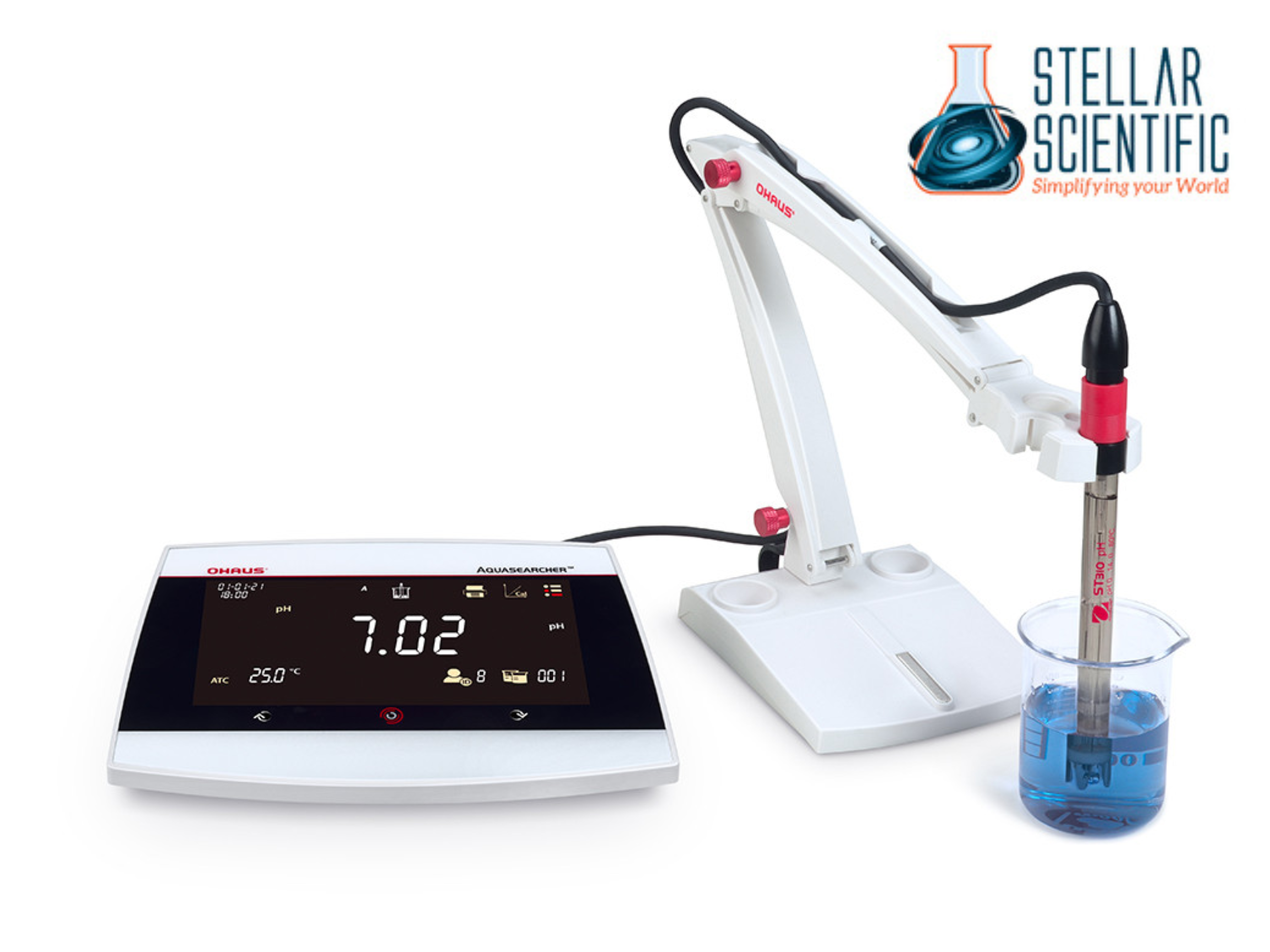
For routine lab needs, the Ohaus AQUASEARCHER AB23PH-B provides dependable performance at a budget-conscious price.
Total Cost of Ownership
Electrode lifespan and replacement frequency represent the largest long-term expense. Depending on sample type and usage, electrodes typically last several months to two years. Cleaning solutions, calibration buffers, and storage solutions should be factored into routine consumable planning.
Decision Framework Based on Common Lab Scenarios
|
Use Case |
Recommended Specs |
Meter Type |
|
Routine buffer prep, QC checks |
±0.01 accuracy, 0.01 resolution, 2-point calibration |
Entry benchtop |
|
Sensitive assays, biotech workflows |
±0.001 accuracy, 0.001 resolution, 3–5 point calibration |
Advanced benchtop |
|
Multi-location sampling |
Replaceable electrode, portable design |
Handheld |
|
Teaching labs / non-critical checks |
~0.1 resolution |
Pen tester |
Common Problems and How to Avoid Them
Drift or inconsistent readings
Often linked to electrode age, insufficient calibration, or temperature differences. Regular calibration and correct storage significantly improve stability.
Slow stabilization or noisy signals
Frequently caused by electrodes that are not appropriate for the sample matrix.
Operator variation
Meters with intuitive interfaces and guided user prompts reduce inconsistencies between users.
Limited traceability
Lack of data logging or export features can create documentation challenges, especially in regulated or QA-driven settings.
What You Can Skip (Depending on Workflow)
- ±0.001 accuracy isn’t necessary for most routine applications.
- Field-rugged housings are unnecessary for fixed benchtop use.
- Advanced connectivity is optional unless digital traceability is required.
Practical Evaluation Checklist
- Required accuracy and resolution
- Electrode match to sample type
- Calibration features + buffer availability
- Data export and logging requirements
- Consumable and replacement electrode costs
- Support and service expectations
- Total cost of ownership over 2-3 years
Next Steps
If you're preparing to select a new pH meter:
- Explore our Ohaus benchtop and handheld pH meter options.
- Visit our Buffers for pH Meters section for calibration and maintenance supplies.
- If you are comparing models or want to verify electrode compatibility, our team is happy to review specifications, confirm availability, and provide pricing.
Stellar Scientific is committed to supplying high-quality measurement tools and supporting labs with reliable instrumentation tailored to scientific workflows.
Ready for a competitive quote? Contact our team today, and we’ll respond quickly with pricing and availability.