
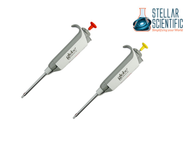
How Do You Choose the Right Volume Range for a Single-Channel Pipette?
10th Feb 2026
Choosing the right volume range for a single-channel pipette directly affects accuracy, repeatability, and long-term reliability. Pipettes perform best within their stated range, and selecting the wrong size can introduce unnecessary variability into routine lab work.
In research, academic, and biotech environments, pipettes are used constantly. Small mismatches between pipette range and actual usage patterns can impact data quality, increase rework, and shorten service life.
What Volume Range Should You Choose for a Single-Channel Pipette?
Most manufacturers specify that single-channel pipettes achieve optimal accuracy between approximately 35% and 100% of their maximum volume. Performance typically declines as dispensing approaches the lower limit.
Typical examples include:
- A 0.5-10 µL pipette performs best above ~3-4 µL
- A 20-200 µL pipette is more reliable above ~70 µL
- A 100-1000 µL pipette performs best above ~350 µL
For most labs, choosing a pipette whose most frequently used volume is near the middle of the range yields the most consistent results.

Is It Better to Use Multiple Pipettes or One Adjustable Pipette?
This depends on volume spread and accuracy requirements.
Multiple pipettes
Labs dispensing across widely different volumes often use two or more pipettes with overlapping ranges. This keeps transfers within optimal operating zones and improves consistency between users.
One adjustable pipette
If work stays within a narrow range, a single-channel adjustable volume pipette may be sufficient. This approach is common in teaching labs or workflows, prioritizing simplicity.
For precision-sensitive workflows, using multiple pipettes matched to specific ranges is typically more reliable.
What Happens If You Pipette Outside the Recommended Volume Range?
Regularly operating near the extremes of a pipette’s range can introduce problems.
Reduced accuracy and precision
At low volumes, small mechanical tolerances have a larger effect, increasing variability even with good technique.
Increased wear and calibration drift
Frequent use of the extreme range stresses seals and internal components, potentially shortening calibration intervals.
Greater sensitivity to technique
Low-volume dispensing is more sensitive to aspiration speed, tip wetting, and inter-user handling differences.
What You Actually Need: A Practical Selection Framework
When narrowing options, these questions help clarify requirements:
- What volume do you dispense most often?
- How many users share the pipette?
- How sensitive is your workflow to small volume variation?
- Are compatible pipette tips readily available?
Answering these questions often leads labs to select two complementary pipettes rather than a single wide-range model.
Common Problems and Practical Troubleshooting
Inconsistent results between users
Often caused by operating near the low end of a pipette’s range. Switching to a smaller-volume pipette improves consistency.
Dispensed volumes appear high or low
Confirm that the pipette is within its optimal range and that tips are properly seated. Calibration may also be needed.
Pipette feels stiff or uneven
This can indicate seal wear from repeated use at the extreme range. Choosing a better-matched range reduces mechanical strain.
Features You May Not Need for Most Pipetting Work
Not every available feature adds value for everyday pipetting tasks. Extra-wide volume ranges are often unnecessary if only a small portion of the range is used regularly, and they can reduce accuracy at lower volumes.
Similarly, over-specifying accuracy may not yield meaningful benefits when relative comparisons or screening suffice. In many cases, choosing the largest pipette “just in case” introduces more variability than flexibility.
Selecting pipettes based on how volumes are actually used in the lab is usually more effective than maximizing specifications on paper.
Making the Right Pipette Choice for Your Workflow
When reviewing single-channel pipettes, it helps to step back and look at how volumes are actually dispensed in day-to-day work. Comparing typical dispense volumes against recommended operating ranges can reveal whether a current pipette is well matched or if a different size would improve consistency. Factors such as usage frequency, the number of users sharing a pipette, and the application's sensitivity to small-volume variation all influence which volume range makes the most sense.
Stellar Scientific works with research, academic, and biotech labs to support equipment selection based on practical workflow needs rather than one-size-fits-all recommendations. Ready to choose the right pipette for your workflow? For questions about volume ranges, availability, or configuration, you can contact us to learn more.