
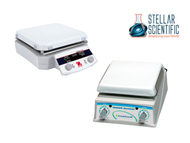
Analog vs. Digital Hotplates and Stirrers: Which One Makes Sense for Your Lab?
29th Jan 2026
How Analog and Digital Hotplates Differ
Analog hotplates and stirrers use manual knobs to adjust heating and stirring speed. The settings are approximate and do not correspond to specific numerical values. These units are generally straightforward to operate and are commonly used for basic lab tasks.
Digital hotplates and stirrers use electronic controls with numeric displays. Users can set specific temperatures and stirring speeds, and the controller adjusts output to maintain those setpoints. Many digital models also include features such as hot-top indicators or over-temperature protection.
The primary difference between the two types is the level of control and feedback available to the user.
A range of analog and digital options is available in the hotplates and stirrers category.
Temperature Accuracy and Repeatability
Temperature accuracy is more critical when results must be consistent across multiple runs or users.
With analog units, the knob position does not correspond to a specific surface temperature. Actual temperatures may vary depending on environmental conditions, load size, or user adjustment. External thermometers are often used to verify temperature.
Digital hotplate-stirrers regulate temperature electronically and continuously adjust output to stay near the setpoint. This can reduce variability during longer runs or when equipment is shared among multiple users.

Typical Performance Characteristics
Performance varies by model, but most laboratory hotplates and stirrers fall within these general ranges:
- Temperature capability: ambient to approximately 120-500 °C
- Stirring speed: typically up to ~150-2000 RPM
- Surface materials: ceramic surfaces are commonly used due to their chemical resistance and ease of cleaning
Multi-position digital units are often used when processing multiple samples simultaneously. Examples include a 3-position digital hotplate-stirrer or a 10-position digital hotplate-stirrer.
When Analog or Digital Units Are Typically Used
Analog hotplates and stirrers are commonly used when:
- Heating or mixing tasks are routine
- Small temperature variations do not affect outcomes
- Simplicity and ease of use are priorities
Digital hotplates and stirrers are commonly used when:
- Temperature control needs to be repeatable
- Multiple users share the same equipment
- Applications involve longer or unattended runs
For applications that require stirring without heating, a digital magnetic stirrer can be used to independently control mixing speed.
Common Operating Considerations
Observed temperature differs from expected values.
This is more common with analog units. Surface or solution temperature can be checked with an external thermometer and adjusted as needed.
The stir bar loses coupling.
This can occur if the stir bar is undersized for the vessel or solution volume. Using a stir bar appropriate for the container size generally improves performance.
Temperature drift during long runs
Digital units with feedback control tend to reduce drift over time compared to manual controls.
Features That May Not Be Necessary for Every Lab
Some features are not required for all applications, including:
- Data logging, when temperature records are not needed
- Maximum temperature ranges well above protocol requirements
- Specialized surface materials are compatible with standard ceramic surfaces.
Selecting features based on actual use helps avoid unnecessary complexity.
Equipment Availability
Laboratory hotplates and stirrers are available in a variety of configurations from multiple manufacturers. Options include analog and digital models, single- and multi-position units, and stirring-only devices. Examples of commonly used equipment include Ohaus hotplates and stirrers, which are designed for general laboratory use.
Frequently Asked Questions
What is the difference between analog and digital hotplates and stirrers?
Analog models use manual controls and are typically used for routine tasks. Digital models use electronic controls and provide more precise temperature and speed settings.
Are digital hotplate stirrers more accurate than analog models?
Digital models generally maintain temperature more consistently because they regulate output electronically rather than relying on manual adjustment.
When is an analog hotplate stirrer sufficient?
Analog units are often sufficient for basic heating and mixing, where small temperature variations do not affect results.
Next Steps
If you’re weighing analog versus digital options or comparing specific models, our team can help you quickly narrow the field. At Stellar Scientific, we work with research labs, universities, and biotech companies every day to match equipment to real applications, not just specs on a datasheet.
You can contact us to request a quote tailored to your workflow, temperature, mixing requirements, budget, and lab environment. Whether you’re equipping a new lab or replacing existing equipment, we’ll help you select a solution that fits your lab's actual operating conditions.